Independent scientific investigation of the environmental impacts of the January 2025 Moss Landing lithium-ion battery fire.
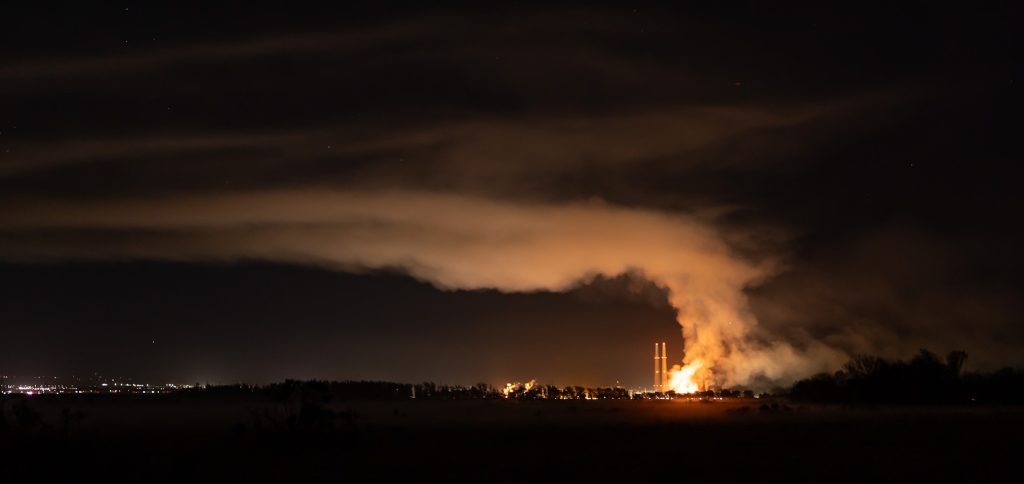
Photo credit: Mike Tataki
Overview
The January 2025 Moss Landing lithium-ion battery fire released airborne particulate matter containing battery-derived metals into the surrounding environment. This research investigates the deposition, transport, persistence, and environmental fate of these materials within coastal wetlands and adjacent ecosystems of Monterey Bay.
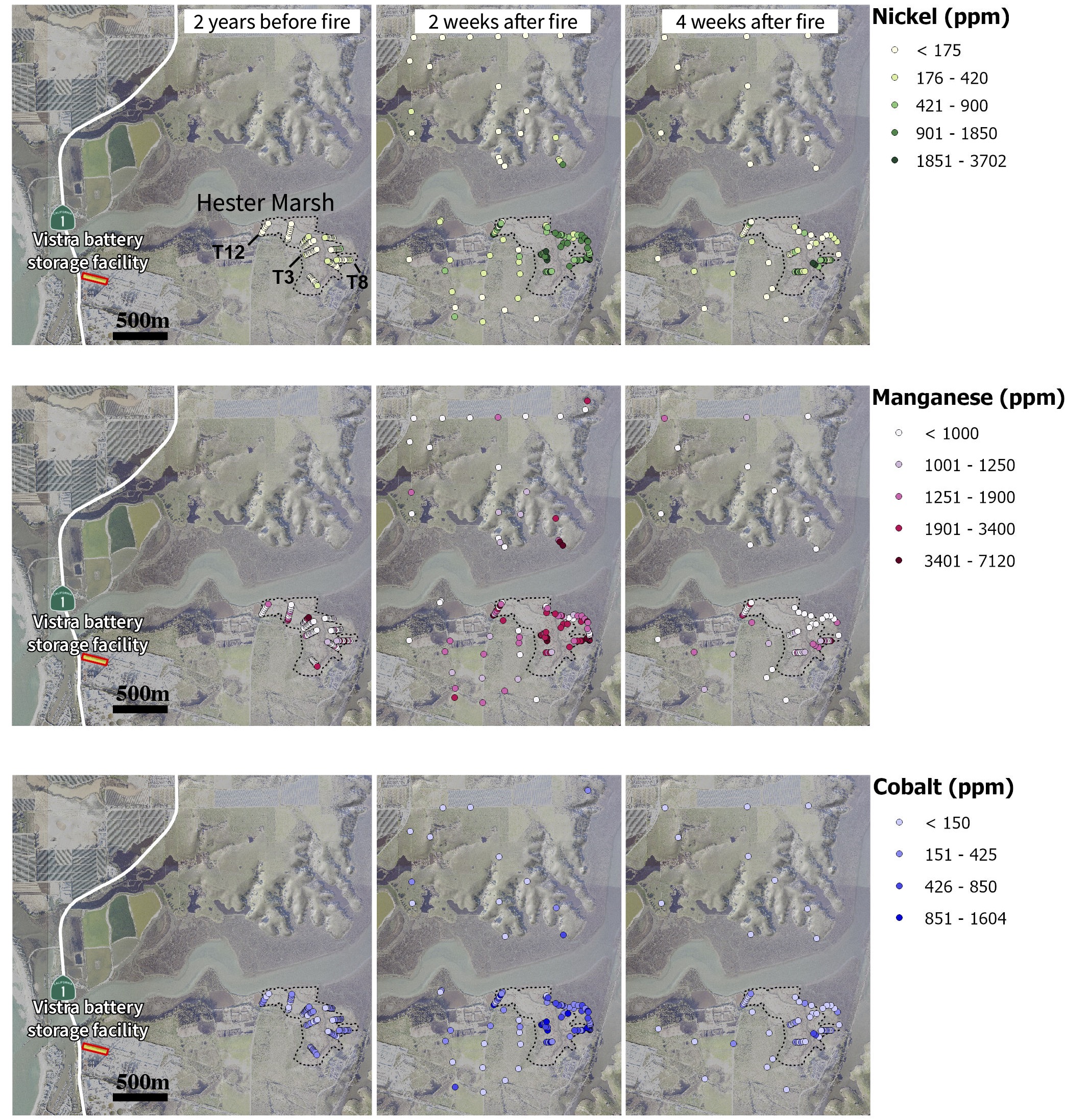
Figure 1. Spatial distribution of nickel, manganese, and cobalt in Hester Marsh before and after the January 2025 Moss Landing battery fire. Elevated concentrations during the first month after the fire demonstrate widespread deposition of battery-derived metals followed by a marked decline. Adapted from Aiello et al. (2025).
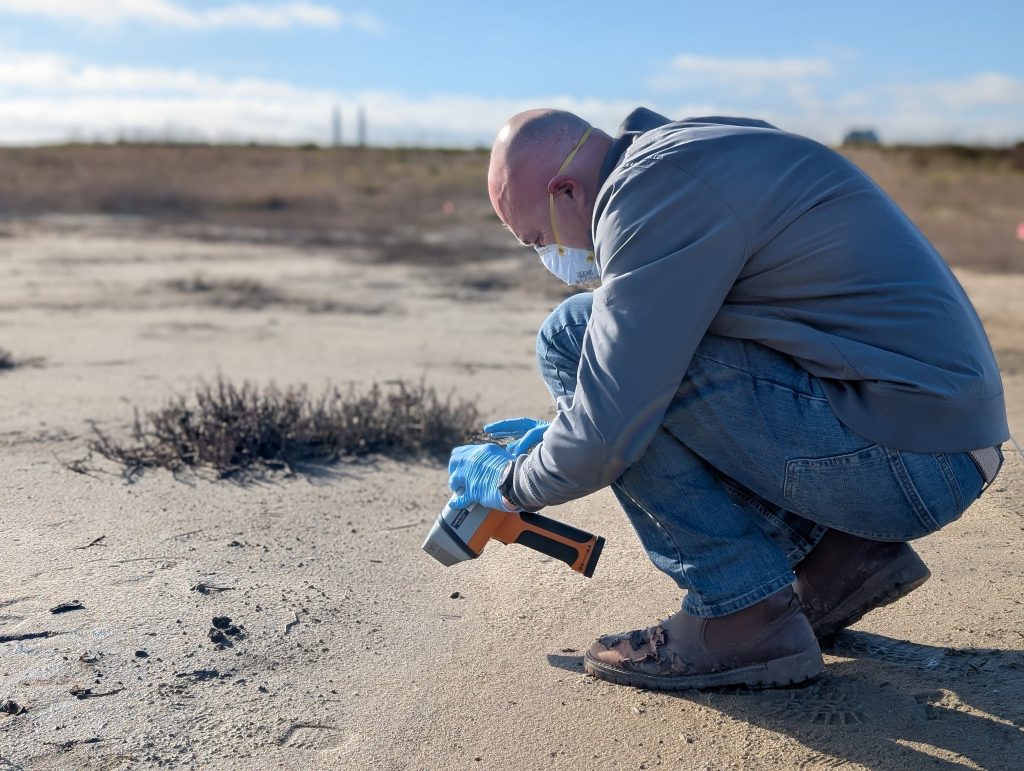
The project combines field sampling, portable X-ray fluorescence (pXRF), laboratory geochemistry, GIS-based spatial analysis, and long-term environmental monitoring to quantify contaminant deposition and evaluate its ecological significance.
The work is conducted independently through Moss Landing Marine Laboratories and San José State University in collaboration with researchers from multiple institutions.
Research Highlights
Key Findings
- First field investigation of the January 2025 Moss Landing battery fire.
- Regional mapping of nickel, cobalt, and manganese deposition.
- Identification of elevated battery-derived metals in coastal wetland soils.
- Spatial analysis of contaminant distribution using GIS.
- Long-term monitoring of environmental persistence and recovery.
Research talk | 2026
Tracking the Environmental Impact of the Moss Landing Battery Fire
What happened to the material released during the January 2025 Moss Landing lithium-ion battery fire?
This talk presents results from our investigation of metal deposition in the surrounding coastal environment, from the initial discovery of unusually high concentrations of nickel, cobalt, and manganese to subsequent efforts to determine their distribution, persistence, and environmental fate.
The work is part of EMBER — Estuary Monitoring of Battery Emissions and Residues, an ongoing effort to understand both the immediate and longer-term consequences of the fire.
Publications
Aiello, I.W., et al. (2025).Coastal wetland deposition of cathode metals from the world’s largest lithium-ion battery fire. Scientific Reports, 15, 42113. [Read the article]
Aiello, I.W. (2025).When the world’s largest battery power plant caught fire, toxic metals rained down – wetlands captured the fallout. The Conversation. An accessible overview of the Scientific Reports study written for a general audience. [Read the article]
Media Coverage
The project has been featured by national and international media outlets, including The New York Times, Los Angeles Times, San Francisco Chronicle, CBS News, NBC News, USA Today, KQED, and many others.
→ View complete media coverage
Research Team
EMBER
Estuary Monitoring of Battery Emissions and Residues (EMBER) is a multidisciplinary research initiative established to investigate the environmental impacts of the January 2025 Moss Landing lithium-ion battery fire. EMBER studies the transport, transformation, persistence, and ecological effects of battery-derived metals in Elkhorn Slough and adjacent coastal environments. The project integrates geology, geochemistry, water chemistry, ecology, microbiology, GIS, and environmental monitoring through collaborations among multiple institutions